
Criminal Court Cases in El Dorado County
The Superior Court of California, County of El Dorado hears felonies, misdemeanors, and some infractions. Its Criminal Division maintains an index of filings and a record of criminal dispositions. A disposition is the result of a charge or case, such as conviction, acquittal, or dismissal. The clerk, not the sheriff or a city police department, keeps the court case file. That distinction matters when the goal is to confirm what prosecutors filed or how a judge resolved the case.
Criminal cases are handled on both sides of El Dorado County. The Placerville Main Street Branch houses Departments 1, 2, 6, and 7, with Departments 1 and 2 assigned criminal pretrial matters and trials. The South Lake Tahoe Branch includes Departments 3 and 4; Department 3 handles criminal pretrial matters, trials, and domestic violence compliance court. The filing location and department shown in the court record identify where to seek copies or calendar details.
El Dorado Criminal Court Branches
The branch split is a practical part of a case search. Placerville Main Street Branch is at 495 Main Street, Placerville, CA 95667, and its criminal line is 530-621-5047. South Lake Tahoe Branch is at 1354 Johnson Boulevard, South Lake Tahoe, CA 96150, with the criminal line at 530-573-3044. Court office and phone hours are 8:00 a.m. to 3:30 p.m. on weekdays, except holidays and closures.
The El Dorado Superior Court Criminal Division describes both locations and payment channels.
The court defines a felony as an offense punishable by death, state prison or county jail, and fines. A misdemeanor is generally punishable by county jail, a fine, or both unless another law sets a different penalty. Those labels describe the filed court matter, not just the booking allegation. A charge first shown as a felony in jail data may be filed differently, reduced through a plea, dismissed, or resolved on another count. The court record is the source for that change.
The court's criminal-division screen shows how local access is organized.
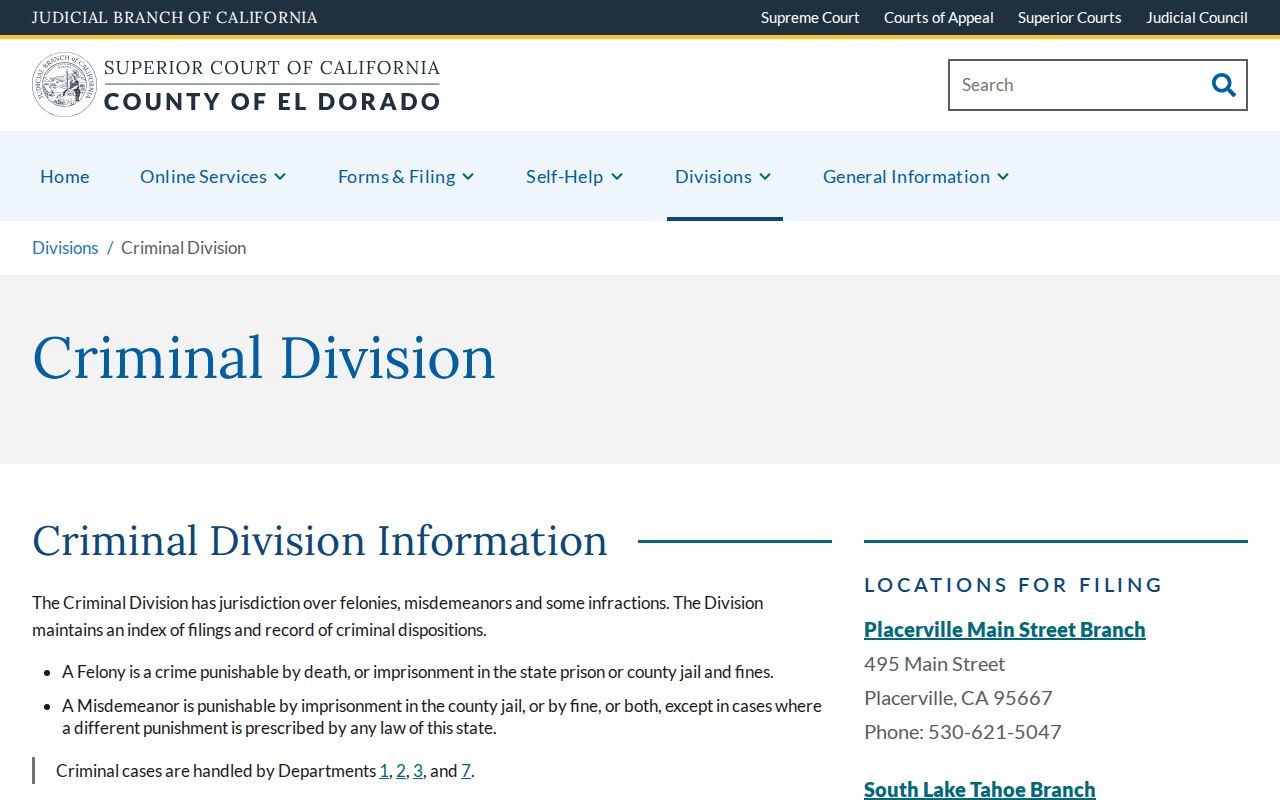
The listed branch connects online case data to the clerk counter holding the official file.
El Dorado County Case Record Searches
Begin at the court's Journal Technologies public portal. The court says it searches case-management data by name, case number, or filing date. A number from a citation, custody entry, notice, or old court paper is the strongest key. For a name search, compare the filing date, branch, and case type before treating a result as a match.
- Open the public portal and select the criminal case data search.
- Enter an exact case number, or search the person's name and compare likely matches.
- Use filing date and court location to distinguish similar names and nearby cases.
- Read the register of actions for hearings, filed papers, pleas, and disposition.
- Submit form M-55 to the right branch for official, certified, older, or offsite documents.
| Field Label | Type | Required | Notes |
|---|---|---|---|
| Name | Text | Unspecified | Use exact and variant names; confirm common names with case details. |
| Case Number | Text | Unspecified | Best when copied from a citation, notice, booking entry, or court paper. |
| Filing Date | Date | Unspecified | Searches criminal, civil, or traffic filings by date. |
| Register | Link | No | Account registration is available. |
| Login | Link | No | Document access can differ from basic case-data access. |
El Dorado Criminal File Copies
The M-55 request form is the route for record research and criminal document copies. A requester may ask for a register of actions, charging paper, disposition, sentencing order, or Penal Code 1203.4 dismissal order. Payment is due in advance. For an older matter that may be offsite, list the years to search and authorize a check amount not to exceed a stated limit. This lets the clerk apply the right search, copy, certification, and retrieval charges.
| Court Service | Fee |
|---|---|
| Search taking more than 10 minutes | $15 per search |
| Copies | $0.50 per page |
| Certified copy | $40 per document plus copy fee |
| Retained judgment from purged file | $15 |
| Offsite file retrieval | $10 per file |
| Rush file retrieval | $40 |
Note: M-55 does not provide police reports, incident reports, transcripts, warrants, confidential documents, or legal research.
What a Criminal Case File Contains
An El Dorado County criminal file records the prosecution after charges reach court. The register of actions gives the event-by-event docket. A complaint or information states the filed allegations. Plea and disposition records show what happened to each count, while a sentencing order states court terms after conviction. These papers are distinct from the arresting agency's report.
A docket entry is a short record of a court event or filed paper. It may identify a motion without reproducing the motion itself. A case can remain open while one charge has already been dismissed. Read the disposition at charge level when the file permits it. A later Penal Code 1203.4 dismissal does not erase the old docket for every lawful purpose, but the dismissal order is key court proof that relief occurred.
| Case Number & Court | Identifies the filing, branch, department, type, and status. |
|---|---|
| Charging Document | The complaint, information, citation, or abstract states filed counts. |
| Docket Entries | The register lists hearings, motions, orders, and filed papers. |
| Hearing Dates | Calendar and docket entries show past or scheduled proceedings. |
| Disposition & Judgment | Shows pleas, verdicts, dismissals, convictions, or acquittals by charge. |
| Sentence & Conditions | Records punishment and court-ordered terms after conviction. |
El Dorado Criminal Departments
The court's judicial assignments place criminal pretrial and trial work in Placerville Departments 1 and 2 and South Lake Tahoe Department 3. Department 3 also handles domestic violence compliance court. Assignments can change, so current court data controls over an old notice.
The assignment table helps when a docket lists only a department number.
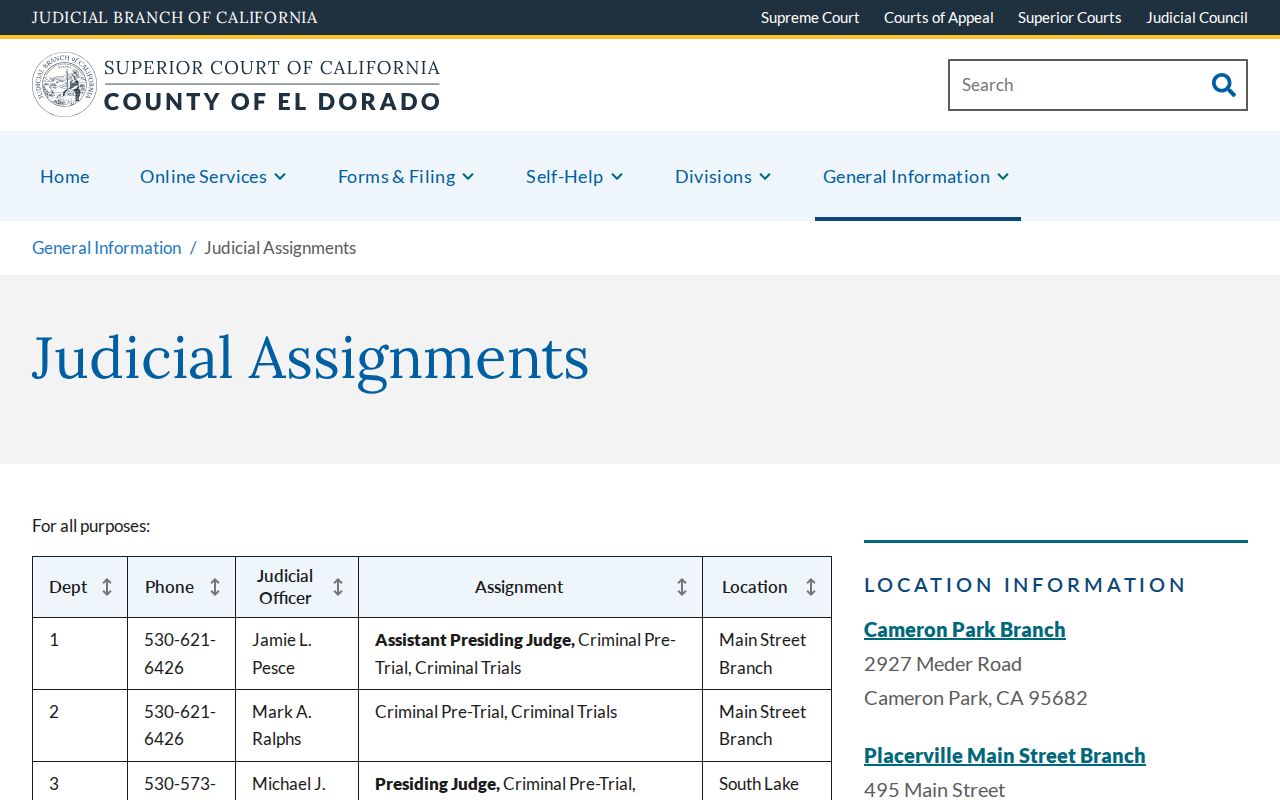
Matching department and branch identifies the clerk line and location to use.
El Dorado Criminal Docket Terms
Several short terms recur in El Dorado County court records. A complaint starts many criminal cases by stating filed charges. An information is a formal prosecutor's charging paper used after preliminary proceedings in some felony cases. Arraignment is the hearing for advisement and plea. The register of actions is the docket history, while disposition means the current or final result. An acquittal is a not-guilty finding after trial. A dismissal ends a count or case without a conviction on that count, or may describe later post-conviction relief under Penal Code 1203.4.
These terms should be read in sequence. A complaint shows the allegation at filing, while the disposition shows what survived and how it ended. The sentencing order matters only after a conviction. This is why a name hit or an early charging document alone cannot answer the outcome of an El Dorado County criminal case.
Criminal Case Stages in El Dorado County
A court case starts when charges are filed. At arraignment, the accused receives the charge and enters or is set to enter a plea. Pretrial events can include motions, evidence disputes, negotiations, and scheduling. The case then resolves by plea, dismissal, or trial. A conviction leads to judgment and sentence. The register of actions best tracks that path because it lists events even when full papers are not online.
The arrest and booking may precede this flow, but they are not court stages. A prosecutor can decline to file, and a filed charge can differ from the booking charge. El Dorado County calendars help confirm the next scheduled event, while the docket preserves the longer trail. No fixed time applies to each stage in the research, so read an old case from its actual entries rather than a guessed schedule.
Case flow: Charges Filed › Arraignment › Pretrial › Plea or Trial › Disposition › Sentencing
Placerville Criminal Court Access
The Placerville Main Street Branch is secured. Wheelchair access is at the rear, with an intercom at that door, an elevator inside, an accessible restroom on the lower floor, and accessible parking behind the building and in the city lot west of it. These facts matter when online data is not enough and a clerk-counter visit is required.
The branch page pairs those access details with criminal contact information.
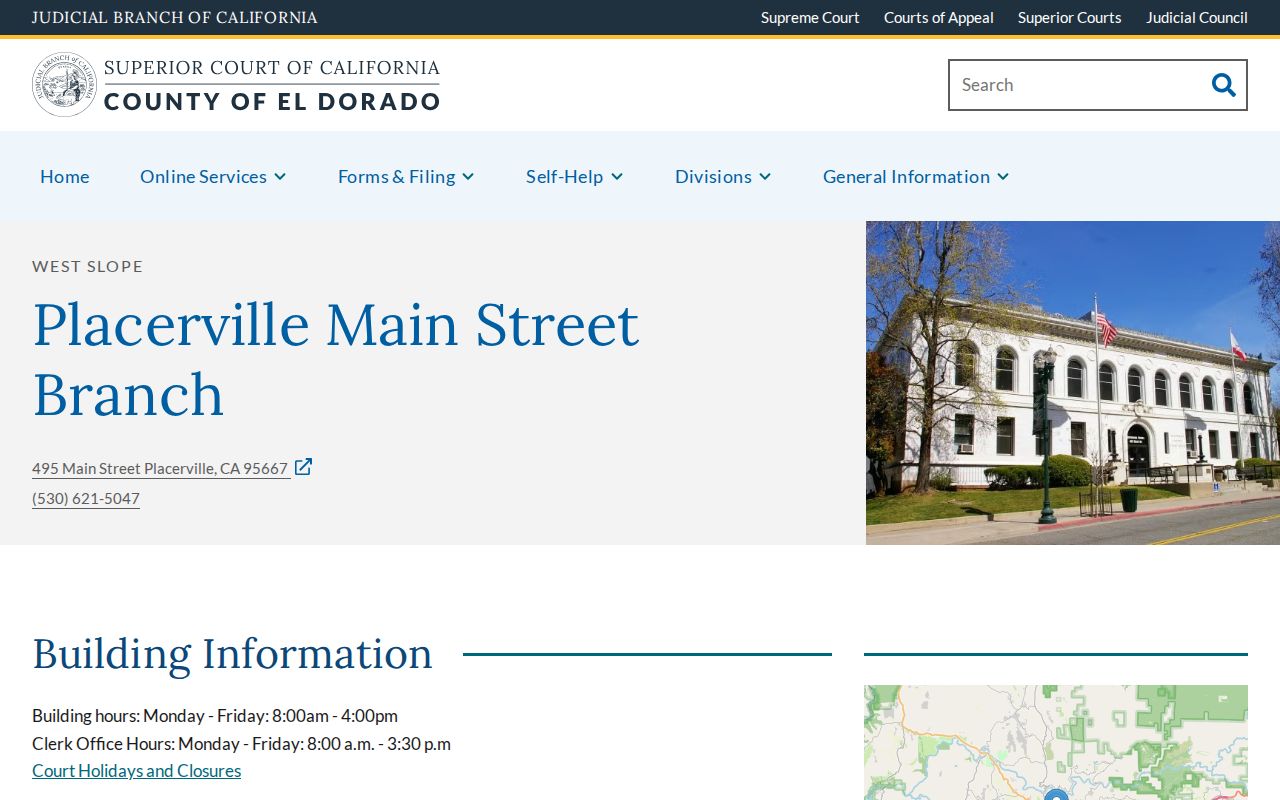
Planning for the secured entrance and rear access can prevent a missed visit.
Access Rules for Case Records
California Rule of Court 2.400 generally makes court records public unless law or a court order makes them confidential or sealed. Rule 2.503 governs electronic public access and permits limits that may not apply at the courthouse. A missing online paper might be available from the clerk, but a sealed file does not open through a copy request.
Juvenile files, victim and minor information, sealed arrests, and court-sealed papers are common limits. For a filed case absent online, give the name, approximate year, and likely branch to the criminal clerk. To trace the event before charges, use the county's arrest history channels.